Here is your other task for this term.
You will need to play scales of C, G and F Major, 2 octaves, Right hand and left hand (not together).
Plus a technical exercises / piece of music. (This will be allocated according to your ability / experience at the keyboard).
Monday, 14 November 2016

Friday, 11 November 2016
Lesson 13 - Friday 11th November
In today's lesson:
Finish the worksheets on Intervals (please leave them in a neat pile at the front of the room at the end of the lesson)
Begin work on this new task. (part 1 only!)
Finish the worksheets on Intervals (please leave them in a neat pile at the front of the room at the end of the lesson)
Begin work on this new task. (part 1 only!)
Monday, 7 November 2016
Lesson 12 - Monday 7th November
Intervals:
To work out the numerical interval between two notes:
Counting the bottom note as "1", count up to the top note.
eg. from C to A (C, D, E, F, G, A) is a 6th.
Similarly, on the stave:

Count all lines and spaces.
Important: There are no exceptions to this rule. Sharps, flats, double sharps and double flats make no difference to the number of the interval.
Major, Minor, Perfect,
Imagine the bottom note of the interval is the first degree of a Major scale.
If the upper note belongs to the scale, it will be:
Major 2nd
Major 3rd
Perfect 4th
Perfect 5th
Major 6th
Major 7th
Perfect 8ve
If you flatten the top note of a major interval it becomes minor.
Diminished, Augmented?
If you sharpen the top note of a major or perfect interval, it becomes augmented.
If you flatten the top note of a minor or perfect interval, it becomes diminished.
Spelling / Enharmonic Equivalent
It is possible for 2 different intervals to sound the same (and be played the same on a keyboard).
eg. From D to G sharp is an augmented 4th
From D to A flat is a diminished 5th
G sharp and A flat are enharmonically equivalent (ie. sound the same and occupy the same space on a keyboards) so these two different intervals sound the same.
The augmented 4th / diminished 5th is also called the tritone for, I hope, obvious reasons.
RESOURCES:
There are excellent online tutorials on numerical intervals, specific intervals and how to write intervals.
You can test how well you recognise written intervals here.
(If you are confident and want to test yourself on more difficult intervals, try this.)

To work out the numerical interval between two notes:
Counting the bottom note as "1", count up to the top note.
eg. from C to A (C, D, E, F, G, A) is a 6th.
Similarly, on the stave:
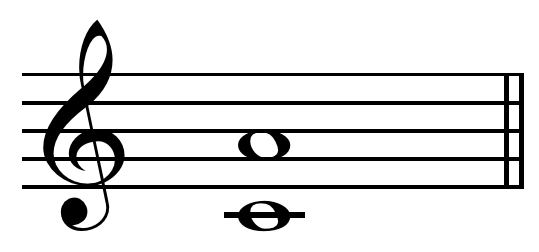
Count all lines and spaces.
Important: There are no exceptions to this rule. Sharps, flats, double sharps and double flats make no difference to the number of the interval.
Major, Minor, Perfect,
Imagine the bottom note of the interval is the first degree of a Major scale.
If the upper note belongs to the scale, it will be:
Major 2nd
Major 3rd
Perfect 4th
Perfect 5th
Major 6th
Major 7th
Perfect 8ve
If you flatten the top note of a major interval it becomes minor.
Diminished, Augmented?
If you sharpen the top note of a major or perfect interval, it becomes augmented.
If you flatten the top note of a minor or perfect interval, it becomes diminished.
Spelling / Enharmonic Equivalent
It is possible for 2 different intervals to sound the same (and be played the same on a keyboard).
eg. From D to G sharp is an augmented 4th
From D to A flat is a diminished 5th
G sharp and A flat are enharmonically equivalent (ie. sound the same and occupy the same space on a keyboards) so these two different intervals sound the same.
The augmented 4th / diminished 5th is also called the tritone for, I hope, obvious reasons.
RESOURCES:
There are excellent online tutorials on numerical intervals, specific intervals and how to write intervals.
You can test how well you recognise written intervals here.
(If you are confident and want to test yourself on more difficult intervals, try this.)
Guitarists and bassists:You may find this useful
Friday, 4 November 2016
Lesson 11 - 4th November 2016

Note:
If a key signature has an F sharp in it, it means that every F, at every octave, will be sharp.
An accidental, (ie. a sharp, flat or natural written next to a note) lasts for the bar (eg. if there is an F sharp, an further Fs in the bar, written at the same octave will be sharpened.)
Here are some exercises to practise writing with and without key signatures.
Friday, 14 October 2016
Lesson 10 - Friday 14th October 2016
In today's lesson we caught up on missing work and made any necessary corrections.
In the first lesson after half term, there will be a test on everything we have covered so far:
Pitches (ie. where notes on the stave)
Sharps and flats
Major Scales (the pattern of tones and semitone and specifically the scales of C, G and F major).
Note values (including rests)
Time signatures
Major and Minor triads
In the first lesson after half term, there will be a test on everything we have covered so far:
Pitches (ie. where notes on the stave)
Sharps and flats
Major Scales (the pattern of tones and semitone and specifically the scales of C, G and F major).
Note values (including rests)
Time signatures
Major and Minor triads
Monday, 10 October 2016
Lesson 9 - 10th October 2016
We played this song on the keyboards.
If you know your major scales, this should be very easy!


Here is a more comprehensive list of 7th chords if you are feeling confident:

Chord sheet is here.
We looked at Sus4 chords, which are explained well here.
Some of you started to look at Seventh Chords
(we will be going back over this so don't worry if you don't get it yet)If you know your major scales, this should be very easy!
The major seventh chord is formed of the 1st, 3rd, 5th and 7th notes of the major scale.
ie. root, major 3rd, perfect 5th, major 7th.
In the minor seventh chord, the 3rd and 7th are flattened
ie. root, minor 3rd, perfect 5th, minor 7th
The dominant 7th chord is more of a mixture:
Root, major third, perfect 5th, minor 7th.

Here is a more comprehensive list of 7th chords if you are feeling confident:
Friday, 7 October 2016
Lesson 8 - 7th October 2016
We listened to this:
Then:
By the end of the lesson, make sure you can play Major triads of:
C, D, E, F, G, A and B Major
If you have time, try the minors as well (the same as major but the middle note is one semitone lower).
Chords:

This is the C Major triad. (Triad means three-note chord)
Here are a load more major triads.

(Notice how in each case the notes go line-line-line or space-space-space.)
A way of working out any major or minor triad:
To play a Major triad: play a note, the note 4 semitones above and then 3 semitones above that.
To play a minor triad: play a note, the note 3 semitones above and then 4 semitones above that.
Then:
By the end of the lesson, make sure you can play Major triads of:
C, D, E, F, G, A and B Major
If you have time, try the minors as well (the same as major but the middle note is one semitone lower).
Those of you who are used to playing chords and are finding it quite easy, try playing the chords with your left hand as well. Also, try using different spacings of the chords (eg. you could play C Major with a C in the left hand and an E and G in the right). Also, you could try different inversions of the chords (ie. with an E or G in the bass instead of a C).
This is the C Major triad. (Triad means three-note chord)
Here are a load more major triads.

(Notice how in each case the notes go line-line-line or space-space-space.)
A way of working out any major or minor triad:
To play a Major triad: play a note, the note 4 semitones above and then 3 semitones above that.
To play a minor triad: play a note, the note 3 semitones above and then 4 semitones above that.
Subscribe to:
Posts (Atom)